Midnight Musings Vol 1

I must be up and out of my home in less than seven hours, but I remain awake, reading NEGRO SUPERSTITIONS by Sara M. Handy, published in Lippincott’s Monthly Magazine, Vol. 48, No. 12, pages 735–739, December 1891.
It is day two of Hoodoo Heritage Month—well, technically day three now. Midnight has come and gone while I’ve been reading...
In the past year, I have grown exhausted with online conversations about Hoodoo. Everyone has to know the most. Everyone has to be the biggest and the bestest, the most authoritative, the keeper of whatever truth everyone else has somehow missed. AI has only made it worse. My feeds are inundated with AI-generated scripts flattening the practice, repeating misinformation, inventing histories, and circulating the same hollow language. I want to scream.
I am bothered. I have been bothered.
But I was guided to lay low.
And so my attention shifted inward. I stopped feeling compelled to enter every conversation or correct every thing I knew to be wrong. I became much more interested in tending to my own practice, listening closely to Spirit, studying the places my people actually come from, and returning again and again to primary sources. Research AS reverence.
I have been deep in the archive.
Apparently deep enough that it is after midnight on a Friday, I have to be on campus at 8:00 tomorrow morning, and I am sitting here reading a 135-year-old account of Black Virginian conjure because I found something that made me sit straight up.
This is the story of my spiritual life.
I am fascinated by what happens when spiritual revelation sends me backward into the archive.
So much of my practice begins there. In dreams. In meditation. In something being revealed to me before I have language for it, and then the scholar in me inevitably wants to know: where has this lived before? What relationships did my people have to this? What does the archive remember that I do not? It's not that I need proof of what I intuitively learn... or maybe I do? Idk.
It is part of why I encourage Black American Hoodoo practitioners to study regionally. Everyone, really. Hoodoo or not. My people are deeply rooted in Tidewater Virginia & New York City, including Black Long Island, and studying those particular landscapes has given me a far more textured understanding of our spiritual traditions than searching for Hoodoo as though it developed identically everywhere Black people lived.
Always, I am following water.
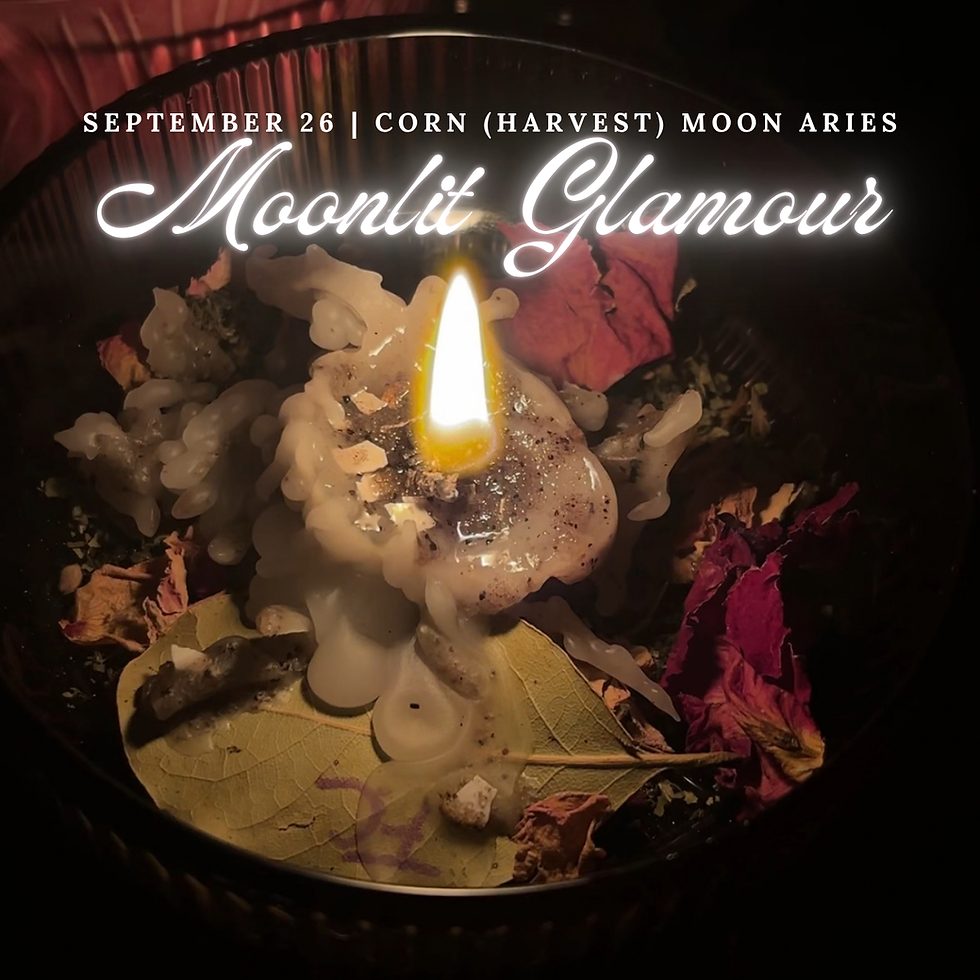
My Moonlit Glamour rituals emerged through spiritual guidance. I was led toward working with water, the body, materia & lunar timing in ways I have never felt the need to declare “traditional Hoodoo.” Revelation does not require me to manufacture historical provenance for it. Still, the archive has a way of answering.
In an 1891 account of Black Virginian conjure, a Black woman was instructed by a conjure doctor to use water her daughter had washed in as part of a working. Her daughter’s personal concerns were incorporated into the preparation, which was then carried to running river water at midnight in the dark of the moon & thrown into the current so that the affliction would be carried away.
Are you kidding me? Are you sitting with the ritual grammar of that:
body → wash water → personal concerns → dark of the moon → midnight → running water → removal
There is an entire cosmology contained in the sequence.
Water has encountered the body, and therefore carries something of it. The work is temporally situated in “the dark of the moon,” as the lunar cycle approaches its disappearance. The river is not scenery, as its movement is operative. What must leave the body is given to water capable of carrying it elsewhere. Diminishment above; removal below.
Water receives. Water carries. Water removes.
And the moon is already there (despite the Hoodoo Bosses claiming our ancestors did not deal with matters of astronomy or astrology 🙄)
I find that profoundly moving because I did not need this account to legitimize what had already been given to me. (Okay, maybe I did. I do be wanting to say "I told you so," but more importantly, I be wanting to preserve our history for real.)
What an honor it is to witness resonance: relationships among water, body, materia, lunar timing & spiritual condition appearing in documented Black practice on land from which MY own people come.
J. T. Roane’s scholarship on Black ecologies & subaquatic life in the Tidewater asks us to consider Black relationships with waterways, wetlands, fish, oysters, crabs & other aquatic life as part of a larger Black social and ecological world. The Great Dismal Swamp holds histories of marronage, refuge & Black ecological knowledge. Across the Chesapeake are Black histories of baptism, maritime labor, river communities & transformation through water.
Anissa Janine Wardi writes of water as a repository of African American memory. Christina Sharpe thinks through the wake, the ship & the oceanic afterlives of slavery. Alexis Pauline Gumbs turns toward marine life as a site of Black feminist study, relation & possibility.
What did water mean to Black people whose worlds were structured by rivers, marshes, swamps, bays & ocean? What did it mean to live beside water that fed you, concealed you, carried you, baptized you, threatened you, liberated you, remembered your dead & sometimes became the very geography through which freedom was possible?
Beyond that, there is another ancestral current I am following.
Through my Shinnecock lineage, I have been reading Kelsey Leonard’s work on Siwá Feminism & Shinnecock Ocean Relationality, where Sea, Ocean, Water & Shore emerge through Indigenous relationship, ceremony, stewardship & womanhood.
Everywhere I turn, I am a woman descended from women whose worlds meet water again & again.
Tidewater. The Chesapeake. The Great Dismal Swamp.
Long Island. Shinnecock Bay. The Atlantic.
I cannot ignore what it means that studying my own ancestral geographies keeps returning me to the same element Spirit had already been teaching me through. Perhaps this is why I am so insistent that people learn to research beyond the word “Hoodoo.”
Search the practice, yes.
But also study the land beneath it.
Study the waterways. Study what grew there. Study what people harvested & ate. Study where they bathed, baptized, escaped, buried, gathered, healed & prayed. Study the ecology alongside the folklore. Study the mundane alongside the mystical.
Sometimes the archive gives you a working.
Sometimes it gives you a cosmology.
And sometimes, if you have been listening closely enough, you realize Spirit sent you toward the question long before you knew there was an archive waiting to answer it.
Research IS reverence.


Comments