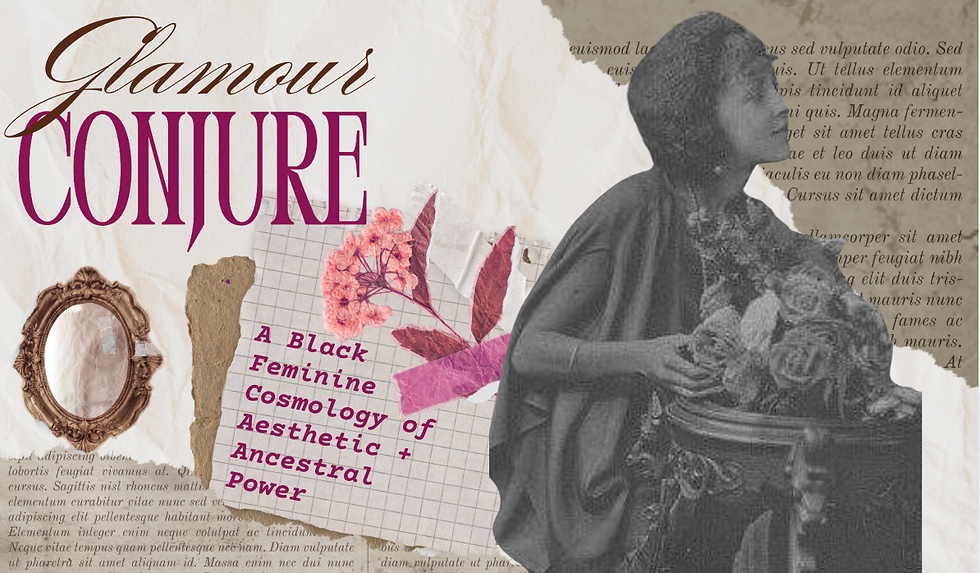
Glamour Conjure: A Black Feminine Cosmology of Aesthetic + Ancestral Power

Updated: Sep 7
Author’s Note, September 2026: Since publishing this piece in April, my articulation of glamour conjure has continued to deepen through study, ancestral work, and the development of its praxis. I have made several minor revisions to better clarify a distinction already present within the original essay: glamour conjure does not reject glamour’s capacity to shape perception, attraction, atmosphere, favor, or reception. Rather, it establishes an order of operation in which the interior must be stabilized before the exterior becomes a site of magical intervention. The gaze can be worked, but it cannot be the source.
These revisions do not represent a departure from the framework first articulated here. They sharpen its language as the practice itself has become more fully legible to me—particularly the relationship between ancestral mediation, interior coherence, embodied presence, and the outward movement of glamour. The central proposition remains unchanged: within glamour conjure, the practitioner stands as descendant before standing as projector, and what moves outward must first have somewhere sacred and coherent to emerge from.
glamour conjure
/ˈɡlæm·ər ˈkʌn·jər/
noun
A term coined to describe a Black American spiritual technology situated within the Hoodoo cosmology and concerned first with the stabilization of self-concept through embodied ritual and aesthetic calibration. Distinct from glamour magick in its cosmological grounding and order of operation, it begins through ancestral continuity, material engagement, and devotional repetition before extending outward into atmosphere, perception, and reception.
A disciplined practice of cultivating presence privately so that public perception cannot destabilize it; a system of atmospheric authorship in which the body functions as altar, archive, and offering.
Glamour conjure does not emerge from fantasy traditions or contemporary aesthetics. It emerges from a historical condition: the disciplined management of Black visibility within regimes that made perception consequential. For Black women in the United States, appearance has never functioned as neutral ornamentation. It has operated within a field of surveillance structured by enslavement, racial science, respectability politics, and ongoing public scrutiny. The body has been read as laboring instrument, sexual object, threat, caricature, and commodity. Within this terrain, beauty practices accrued weight. Presentation became tactical, interior, and cumulative. What I call glamour conjure names the lineage of those practices as sacred technology: a system through which Black women stabilized self-concept, authored perception, and protected interior life through ritualized attention to the body. It is not simply aesthetic refinement; it is a spiritually mediated inheritance carried through bloodline, memory, and disciplined repetition. Before proceeding, however, conceptual precision is necessary. The word glamour circulates widely in popular culture and contemporary occult discourse, often detached from history and lineage. Without distinction, glamour conjure risks being absorbed into frameworks that do not account for its Black American spiritual grounding. To name a practice without situating its inheritance is to allow it to be misfiled.

Within Western esoteric traditions, what is commonly called glamour magick refers to the manipulation of perception through enchantment. The term glamour itself has a traceable linguistic history. According to the Oxford English Dictionary, glamour derives from the Scots word gramarye, a variation of grammar, which in medieval usage referred not merely to linguistic study but to occult knowledge or learned magic. By the seventeenth and eighteenth centuries in Scotland, gramarye had shifted toward meanings associated with spellcraft and enchantment. The transformation of gramarye into glamour as illusion is documented in eighteenth-century Scots vernacular and later popularized in the writings of Walter Scott, who used the term to describe magical deception or the casting of a perceptual spell (Scott, 1805; OED, “glamour”). In this context, to cast a glamour meant to alter how reality appeared to the observer—to impose a perceptual veil. Katharine Briggs, in her foundational work An Encyclopedia of Fairies (1976), notes that glamour in Scottish and Celtic folklore frequently referred to enchantments that distorted sight, causing the viewer to perceive beauty, horror, or transformation where none materially existed. Glamour operated as illusion, not transformation of substance but rather, the manipulation of perception. Its efficacy depended upon altering the field of reception rather than transforming the interior constitution of the practitioner.
This outward orientation persisted into nineteenth- and twentieth-century ceremonial and occult revival movements. In Western esoteric systems influenced by Hermeticism and ceremonial magick, perception itself became a legitimate site of magical operation. As Ronald Hutton documents in The Triumph of the Moon (1999), modern witchcraft traditions that emerged in Britain during the early twentieth century inherited fragments of folkloric enchantment alongside ceremonial ritual structures. Within these frameworks, glamour magick came to signify the deliberate cultivation of aura, projection, and visual charisma through ritual visualization and energetic alignment. The practitioner directs intention outward to influence how they are perceived. The will of the individual functions as the primary engine of operation.
Owen Davies’ historical work on cunning-folk and popular magic demonstrates that early modern European magical traditions frequently included charms for attraction, favor, and social advantage (Davies, 2003). Cunning practitioners in England and Scotland offered services designed to secure love, restore affection, improve reputation, or influence relational outcomes. These charms were pragmatic and often materially grounded, involving herbs, written petitions, planetary timing, or spoken formulae. Yet even in their practicality, their orientation remained outward-facing. The aim was to alter fortune through influence over others’ perception or affection.
By the nineteenth and twentieth centuries, these currents converged with ceremonial magick, Theosophy, and occult revival movements. Within these traditions, glamour increasingly became associated with aura manipulation and psychic projection. The practitioner did not simply wear a charm; she cultivated an energetic field intended to influence reception. Ronald Hutton’s account of modern witchcraft’s development in The Triumph of the Moon (1999) illustrates how folkloric enchantment, ritual performance, and occult psychology blended into new systems of personal magical agency. Glamour, in this context, became less about folk charm and more about the intentional crafting of perceived identity.
Contemporary glamour magick texts make this orientation explicit. Deborah Castellano’s Glamour Magic (2018), for example, defines glamour as “intentional presentation infused with magical will,” positioning aesthetic cultivation as a strategic magical act designed to influence outcomes. Aura work, visualization, confidence-building, planetary correspondences, and ritualized adornment become tools for shaping relational dynamics. The practitioner consciously intervenes in how she is received. Parallel to this development, what is sometimes referred to in online occult communities as vanity magic or “vain magick” has emerged — a loosely defined practice centered on enhancing beauty, magnetism, desirability, or social currency through affirmations, manifestation techniques, beauty routines, and energetic projection. Though often stripped of historical depth, these practices retain the same underlying logic: the magical act amplifies attractiveness in order to influence external validation or opportunity.
Popular media reflects and reinforces this framework. Anna Biller’s The Love Witch (2016) presents glamour explicitly as enchantment deployed through cosmetics, costume, color symbolism, and ritual preparation in order to induce romantic obsession. The film consciously engages mid-century occult aesthetics and second-wave feminist anxieties about seduction as power. Glamour is theatrical, self-aware, and directed outward. The practitioner crafts a surface designed to affect perception. Across these historical and contemporary manifestations, a consistent pattern emerges: glamour operates as enchantment of the gaze. Whether through folk charm, occult ritual, aura cultivation, affirmation culture, or cinematic portrayal, the magical act intervenes in perception. The body becomes the site of projection, beauty is amplified to shape reception, and the practitioner’s will is directed toward influencing what others see, believe, or feel. This does not render glamour magick illegitimate. It situates it. Its cosmology privileges projection and reception, where the gaze remains primary terrain. Illusion, suggestion, and perceptual shaping are central mechanisms. Glamour conjure does not reject these capacities; it reorganizes their sequence and source. Even when ritual materials or desired outcomes overlap, its operative center begins with ancestral mediation and interior stabilization before extending toward external reception.That distinction matters because the question is not whether glamour magick functions. It does. The question is whether projection-centered cosmologies fully account for aesthetic ritual that develops within histories where visibility itself has been disciplined, negotiated, and surveilled. When perception has never been neutral terrain, ritual attention to appearance accrues a different density. It is within that density that glamour conjure takes form.

To ask why this is not simply glamour magick, beauty magic, or vanity magic requires understanding history as constitutive rather than contextual. In many contemporary glamour systems, aesthetic ritual can be approached as a personal technology: shadow work centers individual wounds, confidence practices cultivate self-esteem, and beauty ritual functions as self-expression. Those orientations emerge within traditions where aesthetic cultivation can be conceptually separated from collective historical negotiation. That separation is structurally unavailable in the same way for Black American women. Presentation has operated within regimes shaped by enslavement, racial science, respectability politics, labor stratification, and ongoing public scrutiny. As I write this in 2026, debates around natural hair persist not as aesthetic preference alone but as evidence of a lineage of regulation extending from plantation economies into corporate codes and school discipline policies. Decisions about hair, dress, tone, posture, and visibility have long carried implications for safety, access, and economic survival. The women who preceded us calibrated accordingly. Their negotiations sedimented into interior life, thus, embodiment carries inherited strategy.
Within this terrain, aesthetic practice develops as knowledge production rather than surface enhancement. As I have argued in my work on Black Feminine Cultural Mysticism, Black women have historically generated meaning, coherence, and spiritual technology through aesthetic labor — through hair practices, adornment, fragrance, domestic ritual, dress, and cultivated presence. These practices stored knowledge in the body when formal archives distorted, minimized, or excluded Black interiority. Aesthetic repetition functioned as counter-archive. Glamour conjure arises from this embodied epistemology. It understands ritual attention to appearance as a site where history, memory, and imagination converge.
In beauty magic and vanity magic frameworks, desirability is frequently treated as a neutral aspiration or an energetic condition to be amplified. Within Black American embodiment, desirability has been racialized, policed, commodified, and weaponized. Shadow work unfolds within inherited negotiations with white supremacy, misogynoir, and economic vulnerability. Interiority carries collective memory alongside individual experience. The self is historically textured. Glamour conjure operates within that texture. It treats aesthetic ritual as ancestral dialogue, and as revision enacted in continuity rather than reinvention detached from lineage. Other glamour traditions center projection, aura cultivation, and perceptual influence as primary mechanisms. Glamour conjure centers alignment with inherited currents. Its operative field is relational. Presence gathers through disciplined repetition within lineage. The practitioner stands as descendant before standing as projector. Authority consolidates through ancestral mediation. From that interior and relational formation, atmosphere extends outward. Perception, attraction, favor, and reception may then become deliberate sites of magical intervention without becoming the source from which the glamour derives.
To practice glamour conjure is to inhabit embodiment as historically continuous. The body carries the calibrations of women who navigated constraint, safety, access, and dignity within hostile systems. Their strategies live in preference & restraint as well as in posture and discernment. Aesthetic ritual becomes a site of revision within that inheritance. History is metabolized through repetition. Presence gathers density through continuity. Glamour conjure emerges from that continuity as devotional authorship shaped by lineage rather than isolated will. That lineage is not metaphorical. Within Black American spiritual life, continuity is understood as relational exchange between the living and the ancestral dead. The body serves as conduit as much as canvas. To speak of continuity, then, is to enter a cosmology in which ancestors remain active participants in the shaping of presence.
That cosmology finds one of its most developed vernacular expressions in Hoodoo. Conjure, within Black American spiritual inheritance, emerges from Hoodoo — a spiritual system developed in the United States under the conditions of chattel slavery and its aftermath. Hoodoo is not a direct transplantation of a single West or Central African religion, nor is it reducible to European folk magic. It is a creolized, adaptive cosmology shaped by the forced convergence of West and Central African metaphysical frameworks, regional ecological knowledge, Christian cosmology (in some instances), and the material realities of plantation economies. Scholars such as Zora Neale Hurston in Mules and Men (1935), Yvonne Chireau in Black Magic (2003), and Katrina Hazzard-Donald in Mojo Workin’ (2013) have demonstrated that Hoodoo developed as a distinctly Black American practice. Its metaphysical structure bears clear continuities with West and Central African traditions — including beliefs in spiritual intermediaries, the power of ancestors, the charge of objects, and the relational exchange between visible and invisible realms. The ancestor is not symbolic within this cosmology but active, mediating, and authoritative, participating in an ongoing exchange between the visible and invisible worlds that structures how conjure operates in practice. This spiritual logic governs not only belief, but method... how forces are engaged, how conditions are shaped, and how the practitioner moves within a field that is at once material and unseen.
Within Hoodoo, this engagement does not unfold through a fixed pantheon of deities as it does in many African Traditional Religions, such as Yoruba religion or Vodou, where structured relationships exist between practitioners and named divine intermediaries such as orishas or lwa. Rather, Hoodoo operates through a vernacular cosmology in which spiritual authority is mediated most directly through the ancestral dead, the Bible as sacred text in many cases, and the charged material world. Spirits, in this context, are not approached through formal initiation into priesthood lineages or through codified ritual systems governed by temple structures. Instead, engagement is relational, situational, and often domestic. The practitioner works with ancestors, petitions God/Spirit through scripture and prayer, and activates spiritual force through materially grounded practices using roots, oils, waters, and everyday objects. Conjure, therefore, names not a generalized belief in spirits but a specific mode of operation: the intentional engagement of these forces to shape conditions, restore balance, protect the self, and direct relational and environmental outcomes. Its authority does not derive from institutional hierarchy but from lineage, experience, and demonstrated efficacy. This distinction matters because it clarifies that while Hoodoo shares metaphysical continuities with broader African diasporic traditions, its practice remains structurally distinct, rooted in the historical conditions of Black American life rather than organized religious systems with centralized cosmologies.
Within this materially grounded system, enslaved Africans encountered unfamiliar plants, soils, and climates. Indigenous communities possessed regional botanical knowledge of North American flora, and exchange — sometimes cooperative, often coerced, always shaped by colonial violence — informed how certain herbs and roots entered conjure practice. At the same time, in some instances, European American folk remedies and Protestant biblical symbolism filtered into Hoodoo through proximity and necessity. What emerged was neither purely African nor generically syncretic, but a regionally adaptive Black vernacular system of spiritual technology. Lowcountry rootwork differed from Tidewater practices. Louisiana traditions absorbed Catholic iconography and French colonial influence. Appalachian conjure reflected different plant availability and labor patterns. Hoodoo evolved in dialogue with land, labor, and law. It was shaped by geography as much as memory.
To describe Hoodoo as “forged under slavery” is therefore not rhetorical flourish but historical fact. Conjure developed within a system that criminalized literacy, restricted movement, and weaponized surveillance. Spiritual practice had to be portable, materially grounded, and adaptable. Power moved through what was available: roots pulled from Southern soil, oils mixed in kitchens, and in some regions, psalms recited in hush arbors. It is within this creolized, regionally adaptive Black American cosmology that glamour conjure situates itself.
Any extension of that cosmology, however, requires clarity about its boundaries. Hoodoo is a closed Black American spiritual inheritance. It emerged from the specific historical conditions of American chattel slavery and the long aftermath of racial capitalism, shaped by the descendants of enslaved Africans navigating terror, dispossession, and ecological adaptation within the United States. While its metaphysics bear the imprint of West and Central African cosmologies and reflect regional exchanges with Indigenous plant knowledge and Protestant Christianity, its continuity belongs to Black Americans whose ancestors survived that terrain. Scholars such as Katrina Hazzard-Donald (2013) have emphasized that Hoodoo constitutes a distinct vernacular system rather than a generalized category for Southern folk magic or interchangeable diasporic practice. Its closure is historical, not aesthetic.
The question of who may practice glamour conjure follows directly from the question of lineage. Because glamour conjure situates itself within Hoodoo’s cosmology, its full practice remains accountable to Black American spiritual inheritance. It is not a universal system detached from history, nor a set of techniques that can be adopted through interest or aesthetic alignment. Its authority emerges through continuity, ancestral relationship, and the specific historical conditions that produced conjure as a mode of survival, protection, and spiritual authorship. To remove it from that lineage would be to strip it of the very conditions that give it coherence. At the same time, not every dimension of this work operates at the level of closed practice. There are aspects of attention, embodiment, and ritual orientation that can be engaged more broadly without claiming lineage or authority within Hoodoo itself. What I share publicly, including through the Moonlit Glamour series, reflects that distinction. These offerings do not constitute the full architecture of glamour conjure, nor do they disclose its operative interior. They are partial gestures—points of access into presence, reflection, and sensory awareness—that remain available to those who feel called to them. The practice, however, exceeds what is shared. Its deeper workings unfold through relationship, discernment, and forms of transmission that cannot be replicated through instruction alone.
This boundary also reflects the conditions under which the work itself is guided. My engagement with glamour conjure is not self-derived but shaped through an ongoing relationship with my spirit team—The Royal Court, as I affectionately call them, a name that feels fitting for my lineage. I’m reminded of my psychic medium laughing during a call, “Your spirits are bougie! Well… let me not say bougie. They’re… particular.” And that they are! What is shared publicly is therefore not a comprehensive system but what has been permitted for release. The distinction between what is offered and what is withheld is not arbitrary; it is governed by spiritual instruction, lineage, and an understanding that not all knowledge is meant for general circulation. What appears here, and within the Moonlit Glamour series, reflects only what can be accessed without severing the practice from its grounding. The work itself exceeds what is written. That boundary is not unique to my practice. It reflects a broader principle within conjure itself: that knowledge unfolds through relationship, not acquisition.
Ancestral veneration functions as the appropriate site of discernment. Lineage is not established through affinity, curiosity, or identification with the aesthetic surface of conjure. It unfolds through disciplined engagement with one’s ancestors, through prayer, remembrance, and sustained listening. If one’s people practiced, that inheritance clarifies itself over time. If they did not, that boundary must be honored without resentment or improvisation. Conjure is relational before it is procedural. For this reason, I do not move into operational detail here. I am not outlining formulas, correspondences, or ritual configurations. Conjure operates through transmission and lived continuity; it is not reducible to written disclosure. My task in this writing is to situate glamour conjure within that cosmology, and to clarify its epistemology & historical grounding without exposing the interior architecture of practice.

Glamour conjure arises from this inheritance as a refinement oriented toward embodiment and atmosphere. Hoodoo has long concerned itself with protection, opening roads, securing favor, restoring balance, justice work, and spiritual hygiene. Embedded within those concerns is an understanding that the body is not neutral ground; it is read, interpreted, and situated within power. If surveillance shaped the conditions under which conjure developed, then presence itself required calibration. Glamour conjure extends that logic by recognizing that for Black American women, visibility has never been incidental. The body has been misread, commodified, disciplined, eroticized, and rendered spectacle within regimes that made perception consequential. Within such terrain, aesthetic practice could not remain superficial. It accumulated density because the stakes of embodiment were never trivial. What might appear as adornment participates in the same cosmological field as protection work, operating through repetition, material engagement, and ancestral alignment to shape how one moves through social space. Its efficacy begins before the observer enters the field, through alignment with ancestral currents that stabilize presence from within. From that stabilization, the practitioner may then work intentionally with how that presence travels, registers, and is received.
Where earlier forms of conjure often prioritized survival within hostile systems, glamour conjure attends to sovereignty within and beyond them. Its concern rests in the stabilization of self-concept through embodied ritual so that perception does not fracture interiority. The body becomes a site of consolidation rather than negotiation, and a locus of alignment rather than perpetual defense. Glamour conjure remains accountable to Hoodoo’s historical formation while turning its technologies toward self-authorship, carrying forward a lineage forged under surveillance and adapting it toward interior coherence. The term itself is contemporary; the practice precedes its naming, having been lived, transmitted, and refined across generations without requiring formal designation. In the same manner that “hoodoo” functions as a modern linguistic container for practices that predate its standardization, glamour conjure names a mode of engagement long present within Black American life. What I am identifying is an articulation, drawing these practices into view and rendering their logic legible within the broader architecture of conjure. This is not merely naming, but a theoretical clarification of a distinct orientation within conjure. As both scholar and spiritual practitioner, my investment lies in preserving that inheritance while tracing its continuities and situating aesthetic practice within its proper cosmological frame. Historical awareness grounds the work, yet it cannot remain its only engine. At a certain point, survival must yield to self-gaze; technologies forged under constraint are redirected toward imaginative inhabitation.
In its mature form, glamour conjure turns toward devotional authorship. The question shifts from how the body will be read to how it will be inhabited. Interior coherence precedes external exchange. For Black American women, whose image has been relentlessly produced by others, this shift carries particular gravity. To engage in self-imaging interrupts inherited scripts and relocates authority within the act of beholding. Feminist film theory and Black feminist critique have already demonstrated that looking is structured by power (Mulvey, 1975; hooks, 1992), revealing how vision disciplines and distorts. My work extends that lineage through the erotic self-gaze, an intentional practice of beholding oneself as both subject and beloved, collapsing the hierarchy between watcher and watched and stabilizing presence at the level of sensation. Within glamour conjure, this inward orientation builds density through repetition until sovereignty registers somatically rather than rhetorically, and until coherence is felt before it is performed.
Glamour conjure therefore concerns itself less with negotiating surveillance and more with cultivating atmosphere. The reservoir from which presence emerges is built privately, cumulatively, and devotionally, through sustained alignment between body, spirit, memory, and the material world. Public perception may respond to that atmosphere, but it does not generate it. The source remains interior, structured through ritual repetition and ancestral continuity, and stabilized long before it encounters the gaze of others.
To say that glamour conjure begins in history is to acknowledge its formation within constraint; to say that it turns toward imaginative authorship is to recognize its refusal to remain confined there. It honors lineage without freezing itself inside it. In glamour conjure, presence is never self-generated in isolation. It is mediated through lineage. The practitioner does not simply will atmosphere into existence; they align with ancestral currents that precede them. Devotion, in this context, is relational. The body becomes vessel not only of self-concept but of continuity. Authority emerges through consent with lineage, not merely through confidence or visualization. This relational consent marks a decisive departure from glamour magick’s emphasis on individual will as primary engine. This is what differentiates glamour conjure from projection-based systems of enchantment. Its power is inherited, not invented. Even when gestures appear similar on the surface, their cosmologies diverge in sequence and source. Glamour conjure first seeks to stabilize the soul so that what is projected outward emerges from an interior already made coherent. The gaze may then become a site of magical intervention, but it is never permitted to become the source of the practitioner’s authority.
The same technologies once sharpened for survival are redirected toward inhabitation. What was forged under watchfulness matures into sovereignty. The body, once disciplined for legibility, becomes site of self-inscription. The image, once managed for safety, becomes archive of desire. The mirror, once navigated cautiously, becomes threshold of recognition. In this movement, glamour ceases to function as tactic and settles into vocation. It becomes a disciplined devotional practice of stabilizing self-concept through embodied attention, an ongoing calibration of atmosphere that does not depend on applause or approval.
This is where Black feminine interiority comes into view as lived environment- an inner world shaped deliberately, tended with care, and inhabited with precision. Within Black Feminine Cultural Mysticism, this interiority moves through the body and expresses itself as erotic joy, the capacity to feel deeply without fragmentation; as embodied presence, the ability to remain with oneself under conditions that would otherwise demand dispersal; and as sacred sensuality, the cultivation of sensation, beauty, and attention as sites of knowledge. These are technologies that organize how one lives within oneself and how one moves in relation to the world. Glamour conjure operates within this interior field, refining it, protecting it, and rendering it coherent enough to hold. The work accumulates slowly, shaping posture, cadence, discernment, and relational field over time. Its seriousness is often misread because of its aesthetic form, yet its effects are structural and enduring.
Glamour conjure does not seek to escape history; it metabolizes it. It does not erase the fact of surveillance; it outgrows its authority. What remains is an orientation toward the self as sacred site, the body as living altar, and the image as authored record. Presence, cultivated in this way, becomes offering & coherence, and inheritance extended & carried forward. That extension is the work, undertaken in the company of those whose hands first shaped the technologies that made it possible, sustained through the conditions they taught us to hold, and made visible through how we choose to inhabit ourselves now.
Conceptual Distinctions: Glamour Magick, Beauty/Attraction Magic, Vanity Magic, and Glamour Conjure
Dimension | Glamour Magick (Western Esoteric) | Beauty / Attraction Magic (Folk & Occult Traditions) | Vanity Magic (Contemporary) | Glamour Conjure (Black American Vernacular Cosmology) |
Historical Location | Early modern Scottish folklore (gramarye), later ceremonial and occult revival traditions (19th–20th c.) | Found across European folk magic, Mediterranean love charms, grimoires, and planetary/Venusian workings | Emerges in late 20th–21st century online occult and manifestation-adjacent culture; not historically codified | Emerges from Black American Hoodoo cosmology shaped under chattel slavery and racial capitalism |
Core Aim | Influence perception through aura, charisma, or enchantment | Increase favor, attractiveness, romantic or social desirability | Enhance physical appearance, desirability, or perceived social capital | Stabilize interior sovereignty through ancestral alignment within historically saturated embodiment |
Primary Cosmology | Individual will operating upon perceptual field | Sympathetic magic and petitionary attraction rites (often planetary or spirit-mediated) | Self-concept manifestation frameworks centered on belief and affirmation | Relational cosmology grounded in Hoodoo and ancestral mediation |
Operative Mechanism | Visualization, aura cultivation, ritual charisma work | Baths, charms, oils, petitions, herbs, planetary timing for attraction and favor | Mirror affirmations, scripting, subliminals, beauty routines framed as magical | Hoodoo-rooted ritual technologies activated through ancestral mediation and devotional continuity (procedural details not publicly disclosed) |
Relationship to Visibility | Visibility as terrain of influence | Visibility as opportunity for attraction or relational favor | Visibility as platform for desirability or aesthetic optimization | Visibility as historically regulated terrain requiring stabilization and coherence |
Source of Authority | Practitioner’s trained will and ritual technique | Efficacy of correspondences, spirits, saints, or planetary forces | Individual belief, confidence, manifestation psychology | Lineage, ancestral consent, devotional repetition within Hoodoo cosmology |
Understanding of Aesthetic Practice | Instrument for shaping perception | Instrument for cultivating attraction and favor | Instrument for improving appearance or perceived value | Epistemological site of knowledge production, continuity, and ancestral memory |
Outward Effects | Altered reception, increased charisma | Increased attraction, favor, admiration | Increased confidence, perceived attractiveness, social validation | Presence that carries atmosphere through coherence, historical integration, and ancestral alignment |
Ethical Orientation | Intentional perceptual shaping | Petitionary attraction and relational favor-seeking | Self-enhancement and desirability cultivation | Alignment, continuity, consecrated inhabitation of embodiment |
Concrete Example | Practitioner charges a talisman during a Venus hour and visualizes others perceiving them as magnetic before attending an event. | Practitioner prepares a rose and honey bath with a written petition for favor before meeting a romantic interest. | Practitioner uses daily mirror affirmations or subliminal tracks to manifest clearer skin or increased attention. | Practitioner petitions named ancestors before a public engagement, dresses a candle with clarity-aligned herbs, consecrates distributed materials through spoken intention, and enters the space carrying an established condition of alignment within lineage rather than directing effort toward manipulating perception. |
References
Anderson, J. E. (2005). Conjure in African American society. Louisiana State University Press.
Biller, A. (Director). (2016). The love witch [Film]. Anna Biller Productions.
Briggs, K. (1976). An encyclopedia of fairies: Hobgoblins, brownies, bogies, and other supernatural creatures. Pantheon Books.
Castellano, D. (2018). Glamour magic: The witchcraft revolution to get what you want. Llewellyn Publications.
Chireau, Y. (2003). Black magic: Religion and the African American conjuring tradition. University of California Press.
Davies, O. (2003). Cunning-folk: Popular magic in English history. Hambledon and London.
Hanegraaff, W. J. (1996). New age religion and Western culture: Esotericism in the mirror of secular thought. Brill.
Hazzard-Donald, K. (2013). Mojo workin’: The old African American Hoodoo system. University of Illinois Press.
hooks, b. (1992). The oppositional gaze: Black female spectators. In Black looks: Race and representation (pp. 115–131). South End Press.
Hutton, R. (1999). The triumph of the moon: A history of modern pagan witchcraft. Oxford University Press.
Hurston, Z. N. (1935). Mules and men. J. B. Lippincott.
Lorde, A. (1984). Uses of the erotic: The erotic as power. In Sister outsider (pp. 53–59). Crossing Press.
Oxford English Dictionary. (n.d.). Glamour. In OED online. Oxford University Press.
Scott, W. (1805). The lay of the last minstrel. Longman, Hurst, Rees, and Orme.
Thomas, K. (1971). Religion and the decline of magic. Scribner.


Thank you for sharing, I have been intrigued by glamour for awhile and I understood (surfacely) the varying forms of glamour to be a manipulation of one's perceived projected image which is nice and all but it never fully resonated with me, glamour conjure builds sovereignty of self which also decenters colonial, patriarchal beauty which I've had unknowingly been searching for. I'm intrigued by hoodoo but have been raised on the West Coast and there is definitely a disconnect to my own lineage. Hoodoo seems to be very community oriented, community through lineage and the like.